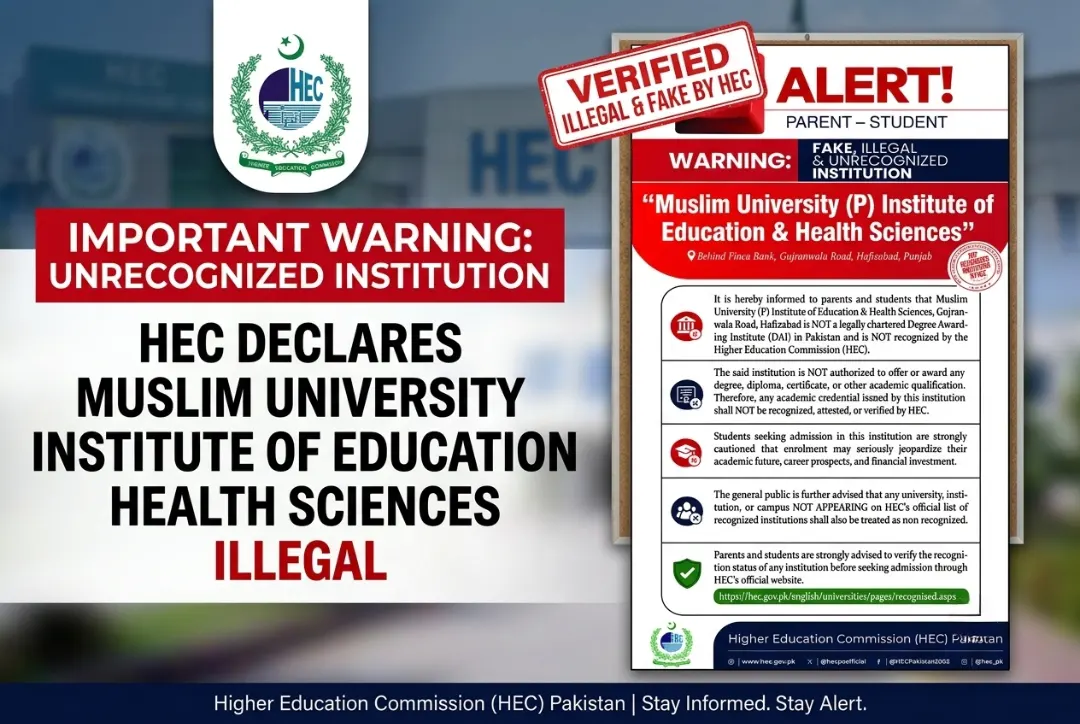
The Higher Education Commission (HEC) has declared the Muslim University Institute of Education and Health Sciences illegal, causing a significant stir in the educational community. This decision by the HEC has raised numerous questions about the institute’s compliance with educational standards and regulatory requirements. The declaration affects many students and faculty, leaving them in a state of uncertainty and prompting widespread debate on the implications for higher education standards and compliance in the region.
Background of the Institution
The Muslim University Institute of Education and Health Sciences, established to provide educational opportunities in the fields of education and health sciences, aimed to cater to a growing demand for skilled professionals in these critical sectors. Founded with promises of quality education, the institute quickly attracted a significant number of students.
However, despite its ambitions, the institute faced scrutiny from various educational bodies regarding compliance with the necessary standards and legal requirements. Its promotional material highlighted a modern curriculum designed to meet international benchmarks, but questions about its actual adherence to these promises persisted.
Understanding the background of this institution is essential to comprehending the current predicament faced by students and educators. The institute’s approach, curriculum, and any prior warnings from regulatory bodies contribute to a fuller picture of the situation.
Historically, many institutions have faced similar scrutiny. The rise of private educational bodies often unfolds with promises of innovation and quality, yet without the requisite infrastructural and curricular investments, the realization of these promises often falls short. This history sets a cautionary framework for evaluating new educational bodies.
Also Read Article: Karachi Airport Marijuana Smuggling Foiled by Pakistan Customs
The Role of the Higher Education Commission (HEC)
The Higher Education Commission plays a crucial role in regulating and maintaining the quality of higher education in the region. It ensures institutions meet specific standards for them to operate legally and effectively. From curriculum oversight to faculty assessments, the HEC is responsible for safeguarding the educational standards.
The decision to declare the Muslim University Institute of Education and Health Sciences illegal did not come suddenly. The HEC often provides institutions with guidelines and ample time to align themselves with required standards. However, persistent non-compliance can lead to more severe actions, such as in this case. Institutions must maintain transparency with the HEC, ensuring they meet all criteria. The HEC’s intervention indicates a breach in compliance that needed addressing, reflecting its commitment to maintaining educational integrity.
Globally, similar regulatory bodies exist with parallel mandates, ensuring that educational institutions live up to the accreditation and operation standards. These bodies often face challenges in uniformly enforcing standards, primarily when dealing with private institutions that have diverse governance structures. The HEC, in this instance, aligns with global trends of increasing scrutiny and enforcement as part of quality assurance.
Impact on Students and Educators
The declaration has put many students’ futures at risk, with their degrees potentially being invalidated. This scenario creates immense stress and uncertainty for current students and alumni. Students may find their qualifications questioned, affecting their career prospects and further education opportunities.
For educators, this situation challenges their careers and academic credibility. Faculty members might face reputational damage, affecting their personal and professional lives. Their association with a now-illegal institution can have long-lasting impacts on their academic records.
Solving the predicament for students and educators involves seeking guidance from the HEC and exploring options such as credit transfers or alternative accreditation, posing substantial challenges but necessary for their careers’ continuity.
Students often navigate such situations by transferring their credits to other recognized institutions, although this requires official recognition of previous coursework. Similarly, faculty members often seek affiliations with other institutions to maintain their standing, albeit facing potential discrimination due to prior associations. Such maneuvers highlight the broader challenges faced by educational practitioners within compromised institutions.
The Importance of Accreditation
Accreditation is a crucial aspect of ensuring educational standards in higher education institutions. It provides a measure of assurance regarding the quality and recognition of the programs offered. When an institution lacks proper accreditation, it risks offering subpar education without accountability.
The Muslim University’s situation underscores the importance of accreditation. The absence of recognized endorsement from an authoritative body like the HEC can have dire consequences, not just for the institution but for everyone associated with it.
Students, before enrolling, should verify the accreditation status of institutions to ensure their prospective degrees hold value in the academic and professional world. This incident highlights the risks of low oversight and the benefits of thorough research before committing to an educational path.
Globally, accreditation is often linked with funding and partnerships, impacting institutions’ abilities to engage in collaborative research and exchange programs. The absence of accreditation not only affects degree legitimacy but cripples an institution’s integration into the broader scientific and educational community, affecting its ability to contribute to global educational dialogues.
Legal and Ethical Implications
The HEC’s decision brings forth several legal and ethical implications for the Muslim University Institute. Among them is the potential for legal action from impacted students seeking recompensation for their invalidated degrees.
Ethically, the institution has an obligation to students and staff to provide transparent information and mitigate the impacts of its illegal status. Possible actions include facilitating credit transfers or even offering refunds, though both solutions involve complex legal and logistic frameworks.
Institutions must adhere to strict ethical guidelines and legal obligations to maintain trust and reliability, vital factors in the field of education. Looking forward, more stringent regulatory practices may be introduced to prevent similar occurrences.
Comparatively, institutions worldwide have faced similar legal predicaments, often resulting in restructuring or definitive financial settlements with affected parties. The financial and reputational fallout extends beyond immediate parties, affecting potential applicants and partnerships. As the legal landscape evolves, institutions are increasingly being required to maintain or exceed baseline operational standards.
Lessons for the Educational Sector
This event serves as a stark reminder for the educational sector about the necessity of compliance and regulatory oversight. Institutions must prioritize maintaining their legal status and accreditation, learning from the consequences faced by the Muslim University Institute.
For regulators, this is an opportunity to reassess and enhance their monitoring mechanisms. Improved oversight could prevent institutions from operating under insufficient compliance, thereby upholding sector standards.
The broader educational ecosystem must adopt more robust checks to ensure institutions provide legitimate, high-quality education. This situation highlights the need for an ongoing dialogue between educational providers and regulatory bodies to align expectations and standards.
In practical terms, the implementation of periodic audits and increased stakeholder engagement can aid in mitigating institutional non-compliance risks. Furthermore, a focus on developing digital transparency tools, allowing public access to accreditation statuses and compliance reports, may facilitate informed decision-making among potential students and faculty members.
Also Read Article : Mass HIV Testing in Pathan Colony Karachi
Comparative Analysis with Similar Cases
Incidents like this are not isolated to one institution or region; they have occurred worldwide, leading to similar debates and repercussions. Comparing the Muslim University Institute’s case with others provides insight into common pitfalls and preventive measures.
Globally, institutions have faced shutdowns due to non-compliance, sparking conversations about regulatory practices. Understanding these similarities can aid in developing prevention strategies, potentially guiding policy amendments for better outcomes.
Examining comparable cases helps illustrate effective responses, allowing stakeholders to manage such crises better, aiming for sustainable educational standards and practices.
For instance, recent cases in Europe where institutions faced suspension due to fraudulent enrollment data revealed regulatory loopholes which have since been addressed with systemic reforms focusing on digital record-keeping and inter-institutional collaborations, offering a potential framework for other regions.
Stakeholder Reactions and Perspectives
The declaration has elicited various reactions from stakeholders, including students, educators, government bodies, and the public. The consensus is frustration and concern for the affected parties’ future within the academic community.
While some stakeholders call for swift responses and support systems for students and staff, others demand stricter regulations and enforcement. These perspectives shape the ongoing discussion about the consequences and needed reforms.
Dialogue between stakeholders is essential for developing holistic solutions that address immediate issues while preventing future occurrences, fostering an environment where educational standards are prioritized.
Among students and faculty, there is an urgent push for immediate solutions, including academic and legal support, reflecting a global trend where the immediate fallout is often inseparable from longer-term systemic reforms. Government entities and educational bodies are challenged to bolster communication lines, ensuring that unresolved academic uncertainty is promptly addressed.
The Future of the Muslim University Institute
Looking ahead, the future of the Muslim University Institute hinges on its response to the HEC’s declaration. Immediate steps might include attempting to rectify identified issues, seeking reevaluation, or potentially restructuring to meet standards.
The institute’s ability to adapt and comply with regulatory requirements will determine its potential for reinstatement. However, rebuilding trust with students and educators will require significant effort and transparent communication. Regaining legitimacy and functionality in the educational landscape involves not only compliance but also regaining stakeholder confidence, a challenging yet essential task for any institution in crisis.
Institutions in similar situations have successfully navigated accreditation reinstatement through strategic partnerships, redefined curricular strategies, and invested in robust governance frameworks. Such strategies indicate that potential recovery, while demanding, is achievable with comprehensive overhaul and transparent institutional practices.
Concluding Thoughts
The declaration of the Muslim University Institute of Education and Health Sciences as illegal by the HEC serves as a critical juncture for those involved in its operation and the broader educational community. This decision brings to light significant issues regarding compliance, accreditation, and regulatory oversight in higher education. As stakeholders navigate the immediate repercussions, it presents a learning opportunity for all educational institutions to ensure adherence to regulatory standards to avoid similar downfalls.
The future journeys of displaced students and educators will largely depend on crisis management strategies employed by the stakeholders. The importance of transparent communication and systemic reform is paramount to restoring trust and securing quality education for all involved parties.
The educational sector must learn from these events, striving towards robust oversight and regulatory frameworks that will safeguard the interests of students and faculty alike, ensuring sustainable educational growth and integrity.
Pioneering New Avenues for Resolution and Growth
As part of the resolution and growth trajectory, institutions involved in similar situations may explore innovative pathways such as collaborations with international accrediting bodies and institutions. These collaborations offer access to broader resources, shared curricular advancements, and potentially, co-accreditation opportunities, thereby enhancing educational offerings and reliability.
Moreover, the adoption of technology-driven educational advancements provides a critical outlook on enriching curriculum delivery. Institutions may employ e-learning platforms that adhere to global pedagogical best practices to further diversify and legitimize their program offerings. Engaging stakeholders through various communication channels optimizes enrolment transparency and institutional accountability.
Innovating Compliance Strategies
Building robust compliance strategies involves a multi-faceted approach centered on the integration of technological advancements and decentralized oversight frameworks. By advancing towards blockchain-based certification and accreditation systems, institutions can ensure integrity and transparency in their pedagogical and operational processes. This system of verification is rapidly gaining traction in educational contexts, highlighting an intriguing intersection between technology and pedagogy.
In parallel, the development of collaborative platforms that facilitate ongoing stakeholder feedback ensures that the institution remains aligned with evolving educational standards. Engaging in continuous improvement cycles alongside accrediting bodies enables proactive adaptation to emerging regulatory shifts, positioning educational institutions at the forefront of quality and compliance assurance.
Frequently Asked Questions
Why was the Muslim University Institute declared illegal?
The HEC declared it illegal due to non-compliance with established educational standards and legal requirements, affecting its accreditation status.
What are the immediate impacts on current students?
Students face the risk of their degrees being invalidated, leading to uncertainty in their academic and professional futures.
How can affected students seek assistance?
Students can seek guidance from the HEC for possible solutions such as credit transfers or alternative accreditation avenues.
What are the legal implications for the institute?
The institution may face legal actions from disgruntled students and staff seeking compensation or alternative solutions.
What can other institutions learn from this incident?
Institutions must prioritize strict adherence to regulations and accreditation standards to ensure their legitimacy and educational quality.




 Muhammad Abdullah |
July 9, 2026
Muhammad Abdullah |
July 9, 2026