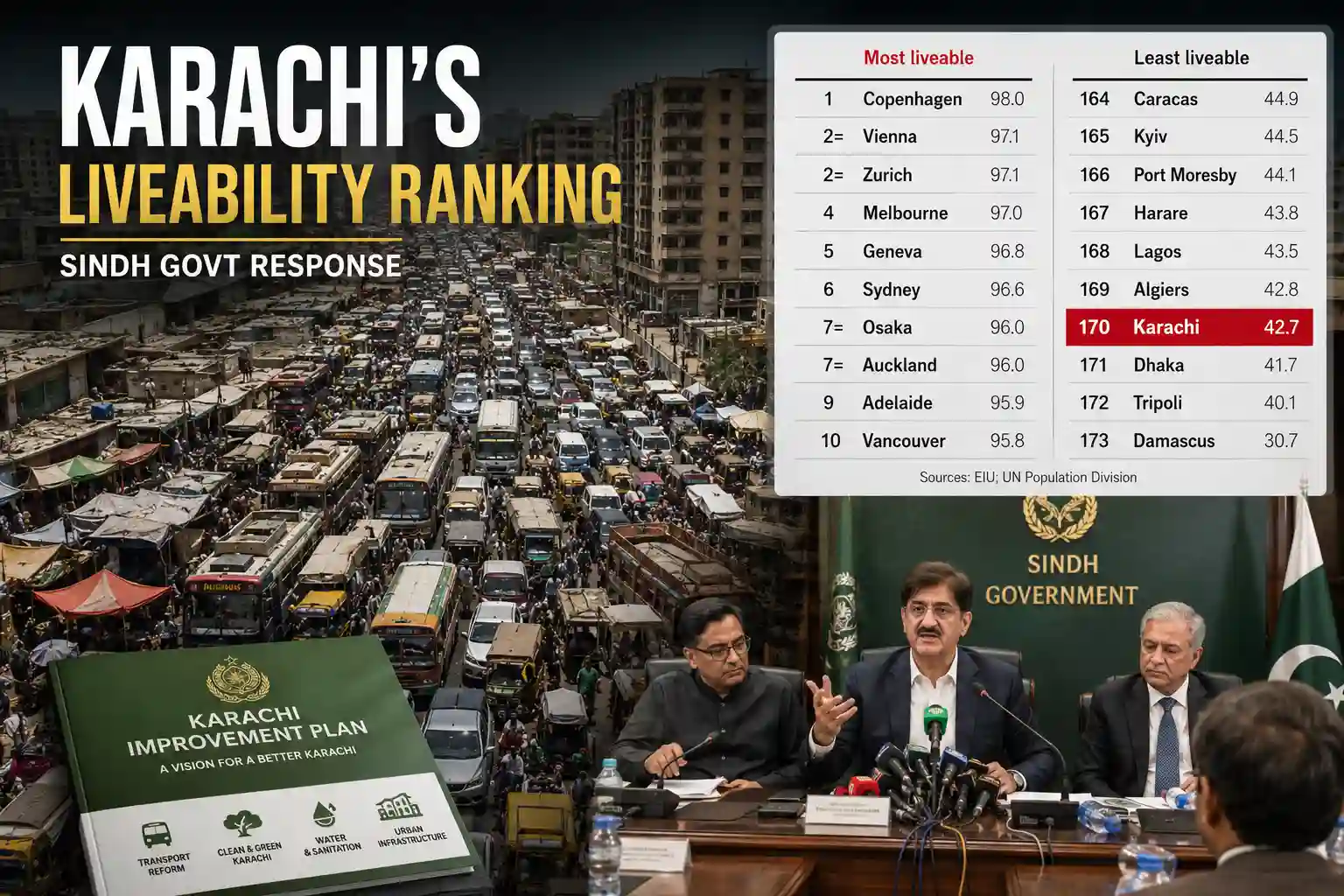
The recent ranking of Karachi among the world’s least liveable cities has stirred significant debate and controversy. The Sindh government has openly rejected this global survey, questioning the criteria and ramifications it holds for the city’s reputation. Karachi, known for its bustling streets and vibrant economic activity, is a city of contradictions a melting pot of culture, history, and commerce. The announcement of its low ranking has ignited a passionate response from local authorities, stakeholders, and residents, who argue that the survey fails to accurately represent the current state and future potential of the metropolis. Understanding both the survey’s results and the Sindh government’s response involves examining multiple facets, from infrastructure and governance to cultural richness and urban challenges.
Understanding the Global Liveability Index
The Global Liveability Index, an annual survey conducted by a respected organization, aims to assess the quality of life in cities worldwide. It typically evaluates over 30 qualitative and quantitative factors across five categories: stability, healthcare, culture and environment, education, and infrastructure. Each city receives a score across these categories, which are then aggregated to form a ranked list.
A crucial aspect of the index involves examining livability from a global perspective, which can sometimes lead to discrepancies in how certain factors are weighted. For instance, while infrastructural challenges in certain cities might be viewed as major hurdles, local governments may be actively working on transformative projects that are not immediately visible in annual rankings.
For Karachi, being placed among the least liveable cities raises questions about the criteria used. Residents and officials argue that while challenges exist, sweeping generalizations do not account for the city’s efforts to improve and adapt.
Moreover, the relevance of the Global Liveability Index lies in its capacity to influence international perceptions and foreign investment. Cities with higher rankings tend to attract more tourism and international business interest. Therefore, a low ranking for Karachi might not just impact its image but also affect economic opportunities. This highlights the importance of transparency in the survey’s methodology, ensuring a fair representation of all cities irrespective of their geographic and economic contexts.
Evaluating Karachi’s Urban Challenges
Karachi faces some undeniable challenges that contribute to its low liveability score, including inconsistent infrastructure, traffic congestion, and issues with public health facilities. As Pakistan’s economic hub, the city’s infrastructure has struggled to keep pace with rapid urbanization and population growth.
Traffic congestion remains a profound issue, often exacerbated by inadequate public transportation options. This affects not only daily commuters but also broader economic productivity. Moreover, the city’s healthcare sector, despite having notable institutions, can be inconsistent, especially in public facilities, leading to variability in healthcare access.
However, each of these challenges is accompanied by ongoing efforts for improvement. Government initiatives aim to address public transit challenges and healthcare disparities. These efforts reflect a city in transition, which might not be captured fully in an annual survey.
The congestion in Karachi is not just a symptom of population growth but also of inadequate urban planning over decades. One must consider the city’s administrative maze, where multiple agencies oversee different urban functions, often leading to redundant efforts and stalled projects. Additionally, the housing crisis is exacerbating vulnerabilities, with scores of citizens living in informal settlements lacking basic utilities and security.
A holistic understanding of Karachi’s urban challenges involves recognizing that these are not isolated issues. Rather, they are interconnected, stemming from historical neglect and rapid, unplanned urban expansion. Tackling these challenges requires a nuanced, multi-dimensional approach involving policy reforms, community engagement, and a long-term vision aligned with sustainable development goals.
The Sindh Government’s Response
The Sindh government’s rejection of the liveability ranking highlights concerns over the methodology and implications of such surveys. Officials have argued that the assessments overlook recent improvements and ongoing projects that promise long-term change.
Emphasizing infrastructure improvements, the government points to major roadworks and transportation projects underway, such as the Green Line bus project, which aims to alleviate some of the congestion challenges by providing reliable and efficient mass transit options.
Additionally, the government highlights efforts to improve public health facilities, increase educational opportunities, and enhance security measures, suggesting that these ongoing initiatives offer a more accurate picture of Karachi’s liveability than the survey results.
In defense of Karachi’s progress, the Sindh government has underscored its commitment to contemporary urban development practices, such as pursuing smart city concepts and leveraging technology to improve public services. Moreover, partnerships with international and local organizations are facilitating innovative projects across health, education, and environmental sectors.
Despite the criticism of the survey, the government recognizes the importance of these indices in providing a benchmark for internal progress. This opens up discussions on aligning developmental policies with the broad parameters of such indices to ensure that Karachi’s efforts are reflected globally. It also involves engaging actively with those conducting these surveys to enhance mutual understandings and expectations.
Also read Article: HEC Declares Muslim University Institute of Education and Health Sciences Illegal
Cultural Richness and Environmental Initiatives
Despite the challenges in infrastructure and governance, Karachi boasts an undeniable cultural vibrancy. The city is a mosaic of diverse communities, languages, and traditions, making it a unique cultural hub in Pakistan.
The arts scene is thriving, with numerous galleries, cultural festivals, and culinary events that attract both locals and tourists. Institutions such as the Karachi Literature Festival have garnered international attention, highlighting the intellectual and cultural richness that defines the city.
Furthermore, environmental initiatives are on the rise. Community-led projects focused on greening the city and improving waste management are gaining momentum and represent a grassroots effort to tackle livability issues.
An exploration of Karachi’s cultural landscape must also consider its vibrant music and theater scenes, where local talents routinely create honest, impactful art that speaks to the city’s diverse experiences. Such cultural expressions play a vital role in forming a civic identity and boosting morale amidst urban challenges.
Alongside cultural endeavors, Karachi’s residents are becoming increasingly conscious of their environmental responsibilities. Grassroots movements have seen impressive success, such as urban farming campaigns making productive use of vacant plots, and charitable foundations tackling pollution and recycling issues. These environmental projects serve as a testament to the city’s rising ecological awareness and determination to combat civic challenges innovatively.
Comparative Analysis with Other Cities
To place Karachi’s ranking in context, it is helpful to compare it with other cities facing similar challenges. Metropolises in developing countries often grapple with parallel issues of infrastructure strain and service provision.
Cities such as Mumbai and Lagos similarly contend with rapid urbanization, yet both have undergone transformations through targeted public policies and innovations in urban planning.
Karachi mirrors these cities in its struggle and potential, and lessons learned from their experiences could inform local strategies in enhancing liveability effectively.
Looking at Mumbai, we witness a city that has managed to improve transportation significantly through strategic infrastructure projects like the Mumbai Metro. Meanwhile, in Lagos, initiatives to streamline regulatory practices and introduce urban reforms are paving the way for systematic growth and liveability enhancements.
Karachi can draw inspiration from these examples, adopting successful strategies while tailoring them to suit its unique socio-cultural and economic context. For instance, employing digital technologies and fostering public-private collaborations could help Karachi leap over traditional development hurdles and achieve notable improvements in urban life quality.
Historical Context and Transformation
Karachi has historically been a city of immigrants and entrepreneurs. Founded in the 18th century, it has grown through waves of migration and industrial booms, each contributing to its complex urban fabric.
This historical context is vital in understanding current challenges. The city has absorbed a multitude of influences, each leaving an indelible mark on its landscape, resulting in numerous challenges and opportunities. As such, any assessment of its liveability must account for both the enduring legacy of its rich past and the transformative efforts underfoot to shape its future. The origins of Karachi as a bustling port city laid the groundwork for its diverse demographic composition. Each era has added to its tapestry, be it through partition influxes or modernization drives, leaving behind a uniquely mixed cultural and architectural heritage.
Recognizing this evolution is pivotal for policy-makers as they navigate contemporary issues. The intersections of historical and current practices dictate social and economic conditions today, providing invaluable lessons on flexibility and adaptation that can inspire innovative and inclusive development policies.
The Road Ahead: Future Prospects
Looking ahead, Karachi’s liveability can improve through comprehensive strategies targeting the root causes of its challenges. Public-private partnerships promise to be a crucial element, as collaboration can yield innovative solutions across sectors.
Furthermore, technological adoption in urban planning, infrastructure development, and service delivery holds potential for significant impact. Smart city initiatives, if implemented thoughtfully, could streamline traffic management and service accessibility.
By focusing on inclusive growth and sustainability, Karachi can leverage its strengths and address its shortcomings, improving its ranking on future global indices.
But beyond infrastructural reforms, improving Karachi’s liveability demands an emphasis on socio-economic inclusion and equitable resource distribution. Bridging income disparities and providing affordable housing are critical interventions that need urgent attention, as they directly correlate with quality-of-life indicators.
Additionally, fostering an informed public dialogue around city governance is vital. Encouraging participatory planning, where residents collaborate with authorities to shape urban policies, can empower communities and build trust, ensuring more nuanced and sustainable urban development outcomes.
Also read Article: Double Death Sentence in Mureed Abbas Murder Case
Grassroots Initiatives and Community Role
Community-driven initiatives play an indispensable role in addressing local liveability challenges. Citizen involvement in urban planning and environmental conservation efforts demonstrates a collective commitment to change.
Efforts such as neighborhood clean-up drives and community gardening projects signify a movement towards self-sufficiency and localized solutions. Communities are recognizing their role in shaping livability outcomes. By fostering a sense of ownership and civic responsibility, Karachi’s citizens can complement formal government efforts, ensuring a more resilient and responsive urban environment.
Furthermore, grassroots networks ranging from local NGOs to neighborhood associations have showcased the potential of collective action in policymaking. These collaborations often provide platforms for marginalized voices, ensuring that urban development is reflective of a diverse range of resident needs.
It is this grassroots dynamism that holds transformative potential. When paired with institutional support, community initiatives can drive sustainable urban transitions, effectively enhancing the quality of life across socio-economic strata.
Reflections on Media Influence
Media narratives significantly influence public perceptions of cities and can either highlight or overshadow their complexities. The focus on rankings often lacks depth and overlooks local narratives.
In Karachi’s case, media portrayal should balance issues with achievements, celebrating cultural and infrastructural initiatives gaining ground. Narrating a city’s duality of struggle and vibrance is essential in understanding its lived experiences.
Comprehensive storytelling about Karachi’s journey can illuminate facets of its past, present, and prospective future, oftentimes obscured by quantitative metrics alone.
Media outlets have a responsibility to present balanced portrayals, emphasizing not just deficiencies but also ongoing resilience and community triumphs. Factual, nuanced reporting can spur constructive discussions and enhance civic engagement, leading to more informed decision-making at both policy and community levels.
As part of this narrative building, alternative media and local storytellers can offer platforms for often-overlooked communities, ensuring diverse voices shape the discourse around Karachi’s image and future potential.
Conclusion: Navigating Perceptions and Realities
In rejecting the global survey ranking Karachi among the least liveable cities, the Sindh government challenges perceptions set by quantitative metrics. While rankings play a role in global discussions on urban liveability, they must not overshadow the intricate realities cities like Karachi face.
The dialogue around Karachi’s liveability provides an opportunity to assess and amplify efforts in urban development, health, culture, and governance. Collaborative strategies, localized solutions, and inclusive planning remain vital in addressing challenges.
Karachi, with its resilience and dynamism, has the opportunity to redefine its narrative on both local and international stages. As it continues on its journey of transformation, acknowledging both its strengths and areas for growth will be key in crafting a future that mirrors its vast potential.
Ultimately, reconciling perception with reality involves transparent governance, strengthened by updated urban policies and grassroots engagement. The focus should be on holistic development, where every stakeholder, from private entities to residents, collaboratively contributes to reshaping Karachi’s urban landscape.
Frequently Asked Questions
What criteria are used in the Global Liveability Index?
The Global Liveability Index evaluates cities based on stability, healthcare, culture and environment, education, and infrastructure to assess overall quality of life.
Why did the Sindh government reject the survey results?
The Sindh government rejected the survey, arguing it overlooked ongoing improvements and initiatives that reflect Karachi’s potential for livability.
What are the main challenges impacting Karachi’s liveability?
Challenges include infrastructural inadequacies, healthcare inconsistencies, and traffic congestion, though efforts are underway to address these issues.
How is the cultural scene in Karachi contributing to its liveability?
Karachi’s cultural vibrancy, highlighted by festivals and the arts, boosts its attractiveness despite infrastructural challenges.
What future steps can Karachi take to improve its liveability ranking?
Emphasizing public-private partnerships, technological adoption, and community engagement can significantly enhance Karachi’s livability in future assessments.



 Muhammad Abdullah |
July 10, 2026
Muhammad Abdullah |
July 10, 2026