




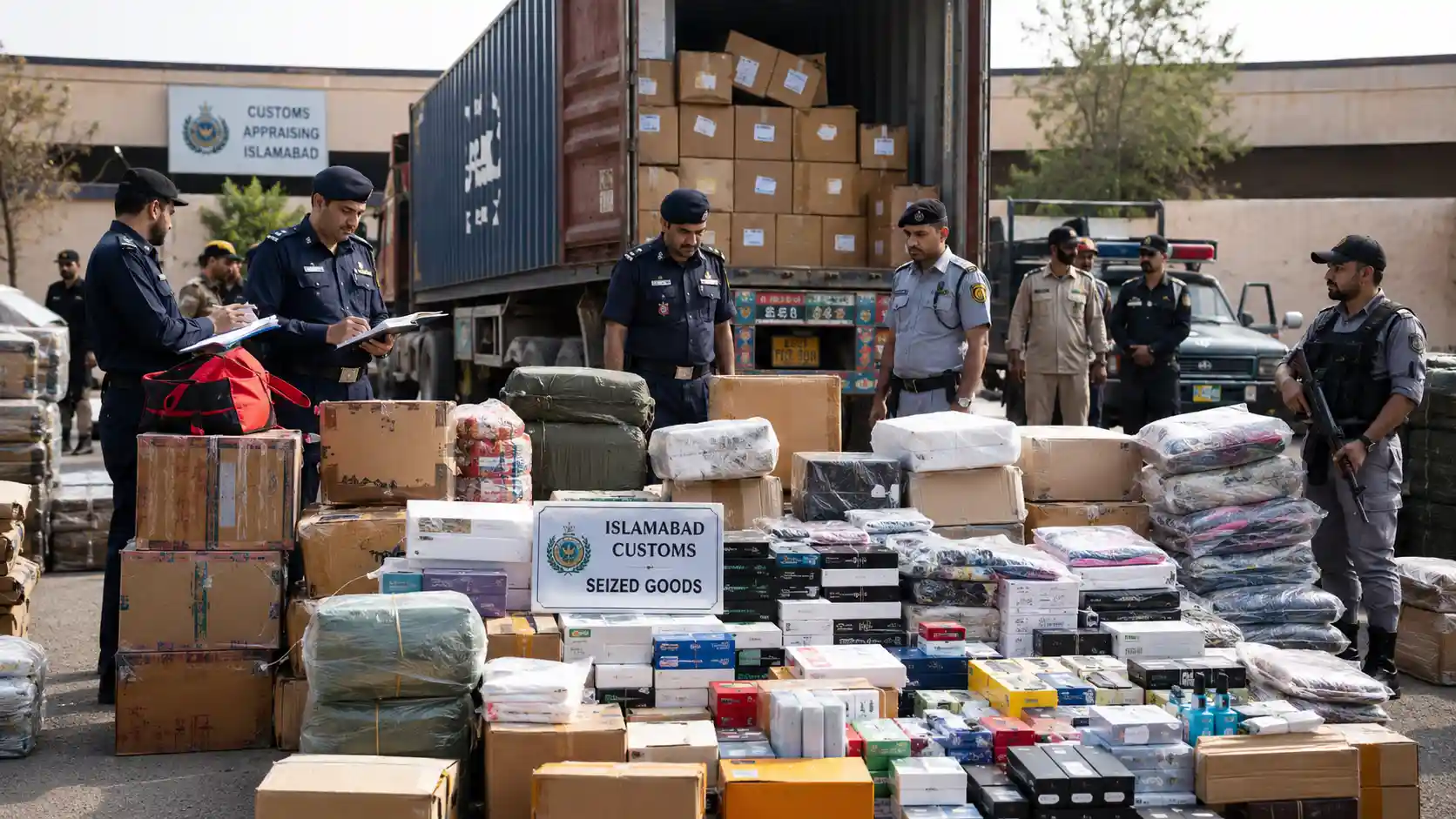

In a significant development, customs officials in Islamabad have confiscated smuggled goods, including non-custom paid (NCP) cars, valued at Rs113.5 million. This major operation underscores the persistent issue of smuggling within Pakistan, with significant economic and social implications for the country. The seizure not only highlights the efforts of law enforcement but also brings to light the complexities involved in combating an entrenched smuggling network.
The Scale and Scope of the Smuggling Problem
Smuggling has long been a prevalent issue in Pakistan, fueled by a mix of economic, geographical, and social factors. The country’s extensive borders, along with varying levels of enforcement, have made it a hotspot for illicit trade. The recent seizure in Islamabad is just a small fragment of the larger picture that portrays a deeply-rooted problem.
Elaborating on the scale, reports suggest millions in revenue are lost annually as goods bypass legal channels. This impacts legitimate businesses, distorts markets, and undermines economic growth. The smuggling industry not only covers consumer items but extends to vehicles, fuel, and even pharmaceuticals.
Efforts to curtail smuggling have been ongoing for years with varying degrees of success. The recent bust in Islamabad, however, indicates a potential upturn in the fight against this illegal activity, hinting at stronger policy implementation and cooperation between agencies.
Moreover, the complexity of smuggled goods networks means they function at multiple levels, involving grassroots operatives to high-level organizers. This makes dismantling these networks not only a matter of law enforcement but a policy challenge requiring comprehensive strategies that incorporate economic reforms and public awareness.
Additionally, the problem is not isolated to Pakistan. Regional dynamics play a crucial part, with neighboring countries often inadvertently contributing due to their own enforcement issues. Understanding the transnational nature of smuggling can guide better bilateral and multilateral collaborations to effectively tackle this pervasive issue.
How Smuggled Goods Enter Pakistan
The entry of smuggled goods into Pakistan is facilitated by various means. The extensive, often porous, borders with neighboring countries are prime channels. Goods are transported on foot, by vehicle, or through more sophisticated methods involving complex networks operating across borders.
Another factor is the use of legitimate trade routes under false pretenses, making detection more challenging. The issuance of fake documents, bribery, and corruption within some sectors of customs further exacerbate the problem, creating loopholes for illegal activities.
Understanding these mechanisms is crucial for formulating effective countermeasures. Stricter controls, technological upgrades in border security, and intelligence sharing among law enforcement agencies are vital in disrupting these smuggling networks.
Additionally, local cultural and social elements can sometimes contribute to the facilitation of smuggling. In certain regions, smuggling may be seen as a traditional livelihood due to economic hardships. This creates a societal norm that complicates eradication efforts, highlighting the need for inclusive community engagement strategies.
Furthermore, the advent of digital technologies is both a boon and a bane. While they aid law enforcement in tracking smuggling activities, they also provide smugglers with innovative ways to conceal and move goods. This perpetual game of cat and mouse necessitates continuous adaptation and updating of tactics by customs officials.
The Economic Impact of Smuggling
Smuggling is not just a legal issue; it significantly impacts the economy as well. The loss of revenue due to tax evasion and customs duties on smuggled goods results in a considerable financial deficit for the government.
This deficit has a ripple effect on public services and infrastructural development, causing setbacks in areas like education, healthcare, and public welfare. Legitimate businesses face unfair competition from smuggled goods, which are often cheaper due to evasion of import duties and taxes.
The broader economic impact includes a distortion of market prices and a decrease in domestic production, which can weaken sectors of the economy reliant on local goods. Combating smuggling, therefore, not only upholds the law but also supports economic stability and growth.
In addition, the illicit economy, fueled by smuggling, gives rise to shadow markets. These markets thrive on instability and contribute to other illegal activities such as money laundering and funding terrorism. Addressing smuggling is, therefore, integral to strengthening national security and fostering a stable economic environment.
Moreover, consumer trust is compromised as smuggled goods often do not meet safety or quality standards. This not only endangers consumers but can also tarnish the reputation of local markets on an international level, limiting foreign investment and trade opportunities.
The Role of Customs and Law Enforcement
The recent operation by customs officials in Islamabad highlights their pivotal role in law enforcement against smuggling. Their duty involves vigilant border monitoring, inspecting suspicious shipments, and collaborating with international counterparts where necessary.
Customs officers rely heavily on intelligence and technological aids, employing scanners, surveillance systems, and data analysis to track illegal activities. The continual evolution of smuggling strategies demands adaptive and anticipatory measures.
Increased transparency and accountability within the customs department can bolster public trust and enhance efficiency in operations. Training and resource allocation are also critical to preparing frontline officers for the challenges they face.
Furthermore, international cooperation plays a critical role. Given the cross-border nature of smuggling operations, joint operations and intelligence-sharing agreements with neighboring nations are crucial. This requires diplomatic engagement and trust-building initiatives to ensure international frameworks are effectively implemented.
Law enforcement agencies must also adapt to the challenge posed by white-collar elements within smuggling networks. High-stakes financial crimes pertaining to smuggling demand expertise in forensic accounting and a deep understanding of international finance to effectively combat and prosecute these sophisticated operations.
Non-Custom Paid Cars: A Target of Smugglers
Among the seized items in Islamabad, non-custom paid (NCP) cars were a significant highlight. These vehicles enter the country without payment of duties and are often resold at lower prices, attracting buyers looking for more affordable options.
NCP cars circumvent legal import channels, posing challenges not just in terms of revenue loss but also in regulatory compliance related to safety and environmental standards. Such cars can undermine the local automobile industry, affecting both sales and manufacturing.
Efforts to counter this issue involve heightened scrutiny of vehicle imports, enhancing registration processes, and public awareness campaigns to discourage purchase of illicit vehicles.
This challenge also extends into the grey areas of consumer ethics and personal responsibility. Increasing consumer awareness about the implications of purchasing NCP cars is essential. Public campaigns and media can play a vital role in educating citizens about the risks and broader impacts of choosing smuggled vehicles.
Moreover, automotive manufacturers can collaborate with the government to incentivize legal vehicle purchasing. Offering trade-in schemes or financial benefits for registered vehicles might decrease the allure of NCP cars, thereby indirectly tackling the problem at its source.
Strategies for Combating Smuggling
Effective strategies to combat smuggling require a holistic approach. Coordination between different government departments, both federal and provincial, is essential. This involves sharing intelligence, conducting joint operations, and reviewing legal frameworks periodically to close loopholes.
Policies that support economic growth, reducing the incentive for smuggling by providing viable economic opportunities, are also crucial. Empowering communities with employment and education can shift reliance away from illicit trades.
Investments in technology such as blockchain for tracking goods, AI for predictive analytics, and drones for border surveillance can significantly enhance law enforcement capabilities.
Educational outreach to border communities and targeted enforcement campaigns can further help to dissuade smuggling operations from taking root. Such outreach strategies should be culturally sensitive and involve local leaders and influencers to maximize impact and acceptance.
Additionally, empowering local law enforcement with community-backed initiatives can create a sense of ownership and responsibility among residents, fostering an environment where smuggling is less likely to flourish. By taking a community-centered approach, the fight against smuggling becomes not just a governmental responsibility but a collective effort.
Political and Social Implications
Smuggling carries significant political and social implications. Politically, it challenges government authority and credibility, particularly if corruption is found within enforcement agencies. It calls for international cooperation to address the cross-border nature of smuggling networks.
Socially, smuggling can contribute to lawlessness and fund other criminal activities. It often involves vulnerable communities, exploiting them as part of transport or distribution networks.
Addressing these implications requires not just a law enforcement response but also engagement with communities to provide support and alternatives to participation in illegal enterprises.
The stigma associated with smuggling may also be a barrier in certain communities, preventing those involved from seeking alternative livelihoods. Providing stigma-free access to education and employment can pave the way for a gradual move away from illegal activities.
On a wider political spectrum, addressing smuggling with integrity can enhance governmental legitimacy and trust among citizens. Transparent operations and visible outcomes in smuggling control can foster a sense of justice and national pride, especially in regions where law enforcement has historically faced criticism.
Historical Context of Smuggling in the Region
Historically, smuggling in Pakistan is not new; it has built over decades, driven by economic disparities and geopolitical factors. From the era of colonial trade controls to the modern-day, smuggling has evolved with changes in policy and economic conditions.
Past efforts to combat it have seen varying success rates dependent on political will, resource allocation, and administrative capacity. Studying these historical trends provides insights into the complexities of implementing effective solutions today.
Analyzing past policies, both successful and unsuccessful, can inform current strategies and ensure that current measures are not just reactive but forward-thinking and adaptive. The inheritance of colonial-era trade routes and their transformation into smuggling channels showcase historical nuances that impact present-day enforcement strategies. Understanding the historical landscape enables governments to devise policies that resonate with current realities while being informed by the past.
The ingrained nature of these routes and methods, built over decades, means that effective solutions must also be intensely focused on understanding cultural, economic, and social dynamics. Legislators and enforcement agencies can benefit from consulting historians and sociologists to provide depth and context to modern anti-smuggling strategies.
Environmental Impact of Smuggling
Illicit trade has often overlooked environmental impacts. Smuggled goods, particularly those that bypass safety regulations, can harm the environment. This includes vehicles that fail emission standards and importation of banned substances like certain chemicals and pollutants.
The globalization of the illegal wildlife trade as part of smuggling networks also has dire consequences for biodiversity. Endangered species are often trafficked across borders, highlighting the need for stringent environmental policies and wildlife protection as part of broader anti-smuggling efforts.
Efforts to curb such environmentally damaging practices require the involvement of environmental agencies working alongside customs departments. Incorporating ecological considerations into anti-smuggling initiatives can aid in developing more comprehensive enforcement strategies.
Looking Forward: The Future of Smuggling Control
The recent bust in Islamabad is a step in the right direction for combating smuggling, but it is clear that a continued, concerted effort is necessary. Future strategies must consider rapidly evolving technology, changing smuggling tactics, and the socio-economic landscape. Public-private partnerships could play a significant role in developing innovative solutions. Engaging technology companies, logistics firms, and others in the broader supply chain can yield new methods for tracking and documenting goods.
The road ahead requires vigilance, innovation, and collaboration. By fostering a comprehensive approach to tackling smuggling, stakeholders can ensure that operations like the recent seizure in Islamabad become part of a sustained effort towards a fairer, more transparent market system.
Encouraging research and development in security technologies and logistics can lead to breakthroughs that redefine border security and customs inspections, ultimately making the movement of smuggled goods less feasible and more detectable.
The empowerment of local communities through participative governance models can also bolster the fight against smuggling. By involving citizens in decision-making processes and enforcement initiatives, the perceived gap between the government and the public can narrow, generating collective action against smuggling.
Frequently Asked Questions
What are non-custom paid cars?
Non-custom paid (NCP) cars are vehicles brought into the country without the payment of import duties or taxes. Their illegal status often makes them cheaper but problematic in regulatory compliance.
How does smuggling affect Pakistan’s economy?
Smuggling causes significant economic harm by reducing government revenue, distorting market prices, and undermining legitimate businesses. It can hinder economic growth and development.
What measures are being taken to combat smuggling?
The government employs various measures, including improving border security, enhancing customs technology, and fostering inter-agency cooperation to tackle smuggling effectively.
Why is smuggling persistent in Pakistan?
Smuggling persists due to factors like extensive borders, economic incentives, and sometimes corruption. Addressing these root causes is essential for long-term solutions.
What goods are commonly smuggled into Pakistan?
Various goods are smuggled into Pakistan, including consumer electronics, fuel, automobiles, and luxury items, often used to evade import taxes and duties.