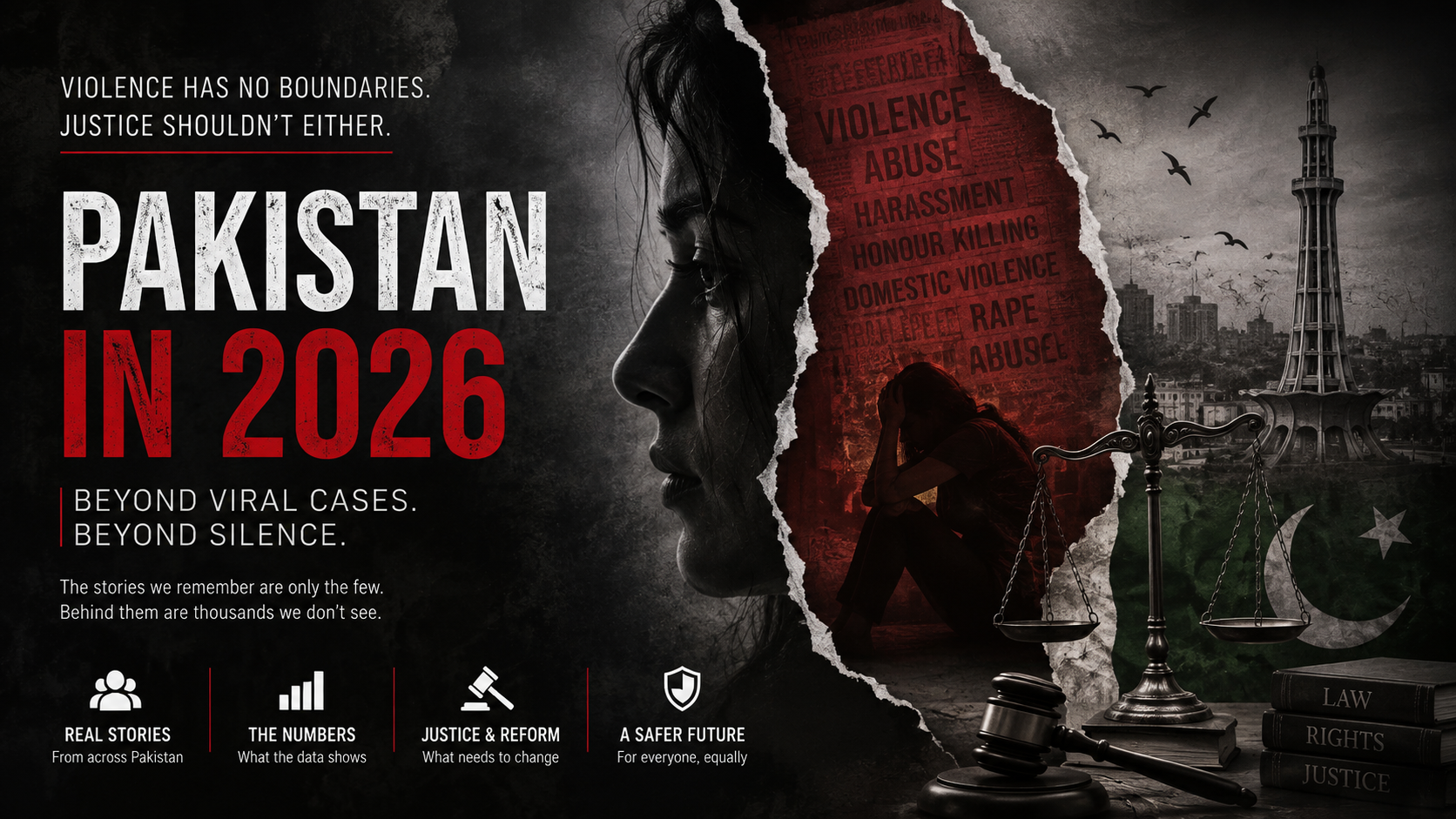
The past few years have been so brutal to our society that every day a new horror unfolds. A predator cares nothing about religion, boundaries, ethics or even empathy. There seems to be no ending to this violence since the loopholes in our system help predators escape, that encourages the future predators too.
A predator does not stop to ask your religion.
He does not ask whether you are Muslim, Christian, Hindu or something else. He does not care whether you come from an educated family or an uneducated one. He does not care whether you live in DHA, an apartment in Rawalpindi, a village in Sindh or an ordinary Nneighbourhood. He does not necessarily care whether you are a woman or a man. And most importantly, a predator does not operate through empathy.
The moment another human being becomes merely something to control, punish, exploit, humiliate or destroy, education, religion, wealth and social status can become irrelevant. That is perhaps the lesson Pakistan needs to understand in 2026. Because violence is not confined to one gender, one class or one kind of household.
A highly educated woman can become a victim. A successful businessman can become a victim. A wealthy young man can become a victim. A woman seeking shelter from her husband can become a victim. A daughter of a diplomat can become a victim. A father driving with his daughter can become a victim. Foreign visitors can become alleged victims.
And sometimes, the person accused of violence is not an uneducated stranger from the margins of society. He may be educated. He may be wealthy. He may come from an influential family. He may be somebody the victim trusted. That is exactly why the conversation needs to move beyond stereotypes.
What the Numbers Tell About Pakistan
The available numbers come from different police departments and organisations and measure different categories. But what we already know is disturbing enough.
According to Sahil’s Six Months Cruel Numbers Report, 3,172 cases of gender-based violence were documented across Pakistan between January and June 2026. Those included 644 murders, 514 cases of torture, 462 abductions, 280 rapes and 132 honour killings, among other offences. Another Sahil report documented 1,914 cases of child abuse across Pakistan during the first six months of 2026. Of those, 1,015 involved child sexual abuse and 558 involved abduction. Girls represented 58 per cent of reported victims and boys 42 per cent. And these are not comprehensive counts of every act of violence occurring in Pakistan. Punjab Police’s own official statistics show that 1,762 murder cases were registered in Punjab alone during the first six months of 2026. In that same six-month period, Punjab registered 20,114 cases classified as crimes against women, including 4,446 rape cases and 940 gang-rape cases. These figures should not be combined into one dramatic total because the datasets overlap and measure different offences.
But they establish something much more important:
Violence in Pakistan cannot be understood through a handful of viral cases alone.
The cases that trend on social media are merely the names we remember. Behind them are thousands whose photographs never appear on our screens.
Hina Javed: Education Could Not Protect Her
Consider Hina Javed.
Forty-five years old. Professionally employed. An adult woman with education and experience. She was found dead inside her Rawalpindi apartment in August 2026, her hands tied behind her back. Police said there were signs of violence and a wire around her neck. A murder FIR was registered, and her husband and domestic servant were taken into custody. Her father-in-law has also remained under investigation. Rawalpindi’s regional police chief subsequently publicly ruled out suicide and described the death as murder. The FIR filed by Hina’s brother also alleged that she had previously been subjected to physical and psychological abuse by her husband. One detail is particularly important. Her husband holds a doctorate. That does not establish guilt by itself; the investigation and courts must determine individual responsibility.
But socially, it destroys an assumption we urgently need to abandon: being educated does not automatically make somebody emotionally healthy, morally responsible or incapable of abuse. A PhD measures academic achievement. It is not a certificate of empathy. And being an educated, professionally established woman does not make someone immune from victimisation either.
Hina Zareef: Sometimes Danger Lives Inside the Family
Hina Zareef’s story raises another uncomfortable reality. Much of our traditional safety advice is built around the stranger. Don’t talk to strangers. Don’t go outside alone. Don’t stay out late. Stay close to your family. But what happens when the person or people you fear are already within that family structure? This is one reason honour-related killings are so difficult to prevent: the danger can exist inside the very social institution that is supposed to provide protection.
The wider statistics reflect that problem too. Sahil’s 2026 reporting found that more than half of documented gender-based violence incidents occurred inside victims’ homes, while acquaintances and husbands together accounted for more alleged perpetrators than strangers. The predator is therefore not always hiding in a dark street.
Sometimes he already has access to the house.
Gulaan Bharo: She Told Them She Could Be Killed
Perhaps no recent case illustrates institutional failure more painfully than Gulaan Bharo. Gulaan was a young mother of two from Sindh who had reportedly suffered abuse from her husband. She sought police help. She asked to be transferred to a Darul Aman shelter. Her husband had allegedly declared her kari. And before returning to her family after assurances that she would be protected, she recorded a statement expressing her fear that she would be killed. On May 2, 2026, she was killed. Her husband and his uncle were subsequently arrested in connection with the killing. That case forces us to ask something far more difficult than, “Why wasn’t the murderer punished?” Gulaan was alive when she asked for protection. What did the system do with that warning? Justice after a death matters. But prevention before a death matters more.
Mir Raza Ali: Education, Ambition and Success Were No Shield
Then there is Mir Raza Ali. Twenty-five years old. An IBA graduate. Entrepreneur. Business owner. He went missing in Karachi on July 28, 2026. His body was recovered the following day in Gulistan-i-Jauhar with a gunshot wound. The case became controversial after questions were raised about the initial autopsy and investigative direction. His body was eventually exhumed. A second post-mortem found multiple injuries to his head and face, fractures, and that the bullet had entered through his back. A murder charge was subsequently added to the case. Mir’s case is important to this discussion because it demolishes another misconception. Crime does not only consume people who are supposedly “vulnerable.”
A confident, educated, entrepreneurial young man can leave his house and never return. His degrees cannot stop a bullet. His ambition cannot protect him from violence. His socioeconomic background cannot guarantee that an investigation will immediately produce clear answers.
Mustafa Amir: Sometimes the Predator Is Someone You Know
Mustafa Amir was 23. According to the prosecution, Mustafa was allegedly abducted and murdered in January 2025 by people described as his friends. Prosecutors allege his body was then transported towards Hub in his vehicle and the car was set on fire. In February 2026, an anti-terrorism court formally charged Armaghan Qureshi and Sheraz alias Shavez Bukhari. Both pleaded not guilty, and the case remains before the courts. Mustafa’s case destroys another convenient safety myth: “Just stay away from bad strangers.” Sometimes danger does not introduce itself.
Sometimes you already know its name.
Noor Mukadam: Wealth and Privilege Could Not Save Her
And then there is the name Pakistan already knows: Noor Mukadam. Twenty-seven years old. Daughter of a former diplomat. Educated. From a privileged background. Living in Islamabad. None of it saved her. Noor was tortured and murdered by Zahir Jaffer in July 2021. In June 2026, almost five years after her murder , the Supreme Court dismissed Jaffer’s review petition and maintained his death sentence.
Noor’s case should have permanently ended one deeply damaging argument: that women become victims because they lack education, financial security or social standing. Noor had all three. Violence found her anyway.
Shahzeb Khan: A Case Pakistan Still Remembers Fourteen Years Later
The same lesson applies to men. In December 2012, 20-year-old Shahzeb Khan was shot dead in Karachi after a dispute that began when he intervened following harassment involving his sister. The case became nationally symbolic because the accused came from powerful backgrounds and because the legal journey stretched across years.
Shahrukh Jatoi and the other accused were initially convicted. Shahzeb’s family subsequently pardoned them, and after years of litigation the Supreme Court acquitted all four accused in October 2022. Whether one agrees with every stage of that legal outcome is separate from what Shahzeb’s case came to represent publicly: the fear that power can alter the experience of justice. Shahzeb was a young man. He was educated. He was from a respectable family. He was not someone society would conventionally describe as helpless.
And he was still killed.
Karsaz: When a Normal Journey Ends in Death
Then consider Imran Arif and his 22-year-old daughter Amna. On August 19, 2024, a Toyota Land Cruiser driven by Natasha Danish struck motorcycles and another vehicle on Karachi’s Karsaz Road. Imran and Amna were killed and three other people were injured. The family later reached a compromise with Natasha, and in October 2024 a Karachi sessions court acquitted her in the manslaughter case after accepting that compromise. This case is different from an intentional murder.
And that distinction matters.
But it belongs in the wider conversation about human life, responsibility and accountability because two people left home that day expecting to return.
They never did.
Two Foreign Women: Status Must Never Become Immunity
In July 2026, another case challenged Pakistan’s institutions. Two foreign women reported being kidnapped, extorted and sexually assaulted in Lahore. An FIR was registered against multiple suspects, including Raza Dar, described in reporting as a relative of a senior political figure. The women’s accounts were recorded before a magistrate, and police pursued forensic evidence and arrested suspects. The allegations remain subject to judicial proceedings and should not be presented as convictions.
But this case raises a simple principle.
If an accused person is connected to political power, wealth or influence, they deserve exactly the same due process as anyone else. No less, and no more. Political connections must neither prove guilt nor provide protection from investigation.
That is what equality before law means.
Stop Searching for the “Type” of Person Who Becomes a Victim
Perhaps this is where Pakistan repeatedly gets the conversation wrong. After every tragedy, people search for an explanation in the victim. Why was she there? Why did he meet those people? Why did she remain in the marriage? Why did he confront them? Why did they go out? Why did she trust him? But look at the names. Hina was 45 and professionally established. Noor was 27 and privileged. Mir was an educated entrepreneur. Mustafa was a young man. Shahzeb was a 20-year-old man defending his sister. Gulaan was a mother of two trying to escape abuse. Imran was a father simply travelling with his daughter. There is no single victim profile. And that is exactly the point.
Predators do not require their victims to be uneducated, poor, female, weak or socially isolated.
Vulnerability can be created in a moment. By physical force. By a weapon. By emotional control. By financial power. By family pressure. By social influence. By reckless behaviour. Or simply by being in the wrong place with someone willing to disregard another human life.
Education Is Not the Opposite of Violence
Pakistan often treats education almost as a moral qualification. If a person is educated and an abuser at the same time, our brains cannot simply process it. We say, he is education, come from a good family, has a respectable profession, hence the allegations might be wrong. Remember, when the abuser has a good reputation, the victim not only fights him, but also his reputation. Remember that education doesn’t give you a character certificate, it simply means you’re well taught, knowledgeable, and skillful.
The Real Question Is Not Who Is Safe
Maybe we need to stop asking:
“Which type of person is safe from predators?” Because the evidence keeps telling us the answer: No category is automatically safe.
The better question is: How difficult do our institutions make it for a predator to act without consequence? Can a woman reporting domestic violence obtain immediate protection? Does the police take a missing young man seriously during the first critical hours? Are forensic procedures strong enough that families do not have to fight for a second post-mortem? Can political influence interfere with an investigation? Are victims of sexual assault protected while giving evidence? Do courts resolve cases quickly enough for punishment to actually deter others? Are families taught that “honour” can never justify violence? Do young people learn that rejection is not humiliation, consent is not negotiable, anger does not create ownership and another human being is never property? These are harder questions than demanding another execution after another viral murder. But they are the questions that actually prevent the next one. Pakistan does not merely have a crime problem.



 Muntahina Shakoor |
August 25, 2026
Muntahina Shakoor |
August 25, 2026